Thursday, 19 September 2024

How much extra output do we get if we invest more?

 This expands on today's earlier post.

How much extra output do we get if we invest more?

How much extra output do we get if we invest more? Here’s some rules of thumb.

1.       From the RF growth mindset report, some useful data as background.

2.       Here’s our underperformance relative to the G7


3.       And here it is in bars:


4.       So we might regard our target is

a.       To get the US GDP per capita growth rates, we need another 1.55-1.03 = approx 0.5% growth per year.

b.       Notice that’s relative to the USA, relative to EU would be much less than that.

5.       How can we get to this via capital investment?  Here’s the tyranny of numbers.

6.       The extra output from 1 extra unit of capital sounds like an engineering problem.  But we can use some economic reasoning to get some measures.

7.       The average rate of return on capital is about 0.10 as measured by the ONS.  That says that the flow of profits from the existing capital stock in the UK, as a percentage of that capital stock, is just below 10%. 

8.       Let’s take a concrete example to check this.  In Feb2024, according to IBA Aero, the price of a new A320neo was $52m.  The monthly rental cost was $400,000.  This ratio is 9%.  So that says that airlines are incurring a cost of renting a new aircraft that is 9% of the capital stock they would have to buy.

9.       If we further assuming that airlines are maximising profits, then they would rent more and more aircraft until the extra flow of output they can sell from renting another aircraft were equal to the extra costs.  But we have just worked out the extra costs are 8%. 

10.   That gives us part of the answer: for every increase in capital stock by one unit, output rises by 0.08 units (0.1 units for the economy as a whole)

11.   It’s more helpful to convert that into a percentage.  We can do this if we express the change in output following a change in capital, the 0.1, as a proportion of the baseline output/capital ratio.  That ratio, for most developed economies, is around 3.

12.   Thus we have the following:

a.       Average rates of return are around 0.1.  This tells us the extra output from one more unit of capital.

b.       Average output/capital is 3. 

c.       So the percentage extra output from a one percentage extra capital is 0.1/3 = approx. 0.3.

13.   What percentage rise in output do we get from a percentage rise in capital then?  For the economy as a whole the rule is


% rise in output from x% rise in capital asset A= 0.3 * share of capital asset A in the economy * % change in capital asset A.

14.   Let’s apply this rule to housing.  It is planned to raise housing input by 0.3%.  Housing is 40% of the total capital stock.  Thus the expected % rise is 0.3*0.4*0.3% =0.036%.  


Will building more houses boost growth?

An excellent meeting at the Resolution Foundation this morning discussed this point, following their new report, "The growth mindset: Sizing up the Government’s growth agenda" by Emily Fry & Gregory Thwaites.

1.  The new government is commited to building more houses.  It says this will boost growth, see their note 27.

2. Let's first be clear on levels and growth.  Will building more houses boost the level of GDP?  As Rupert Harrison on the panel said, this is what most people think. 

To most people, building more houses means allowed more people wearing hard hats producing some output. Surely that that must boost GDP?  Part of the job of economists, aside from quantifying things, is to point out unintended consequences. It is of course true that building more houses, with nothing else changing will raise measured GDP. Part of the components of GDP is investment come up and housing is an important share of investment.  So the question is will anything else change? As Rupert Harrison pointed out, All the estimates we have for the current economy is that it is running at full capacity. That means that any additional activity in housing simply transfer's activity away from other parts of the economy. In other words, what one might loosely call unintended consequences, turn out to be the key effect. Thus there is no effect on the level of GDP Via this mechanism.

This mechanism is a demand mechanism. That is to say, the mechanism most people have in mind, of more people wearing hard hats building buildings, is a mechanism whereby there is increased demand for resources in the economy, and that increased demand raises GDP common sense GDP measures the resources that the economy is producing. As is clear in this example, GDP will only rise if the increased demand is matched by supply (Or if there is surplus capacity in the economy set the increased demand does not displace any existing activity).

3. So what is the effect on supply? This is where the resolution foundation report very helpfully does the mathematics.

Their Figure 5 below sets out the data.  


The extra new housing that the report identifies turns out to be around 1.1% of the stock of housing. This in itself is an interesting number and shows the value of undertaking these calculations.  The announced target, of 1.5 million homes over 5 years sounds like a large number. But this is an extra 60,000 homes per year over and above what we are already building. The key point is that there are around 30 million dwellings already existing. Thus the additional building over 5 years is around 0.2% of the stock of existing buildings. Thus the question is: what is the additional effect on the supply side of the economy of increasing the stock of existing buildings by 0.2%?

Is that we need to know how much extra output we get from a certain percentage change in the capital stock. Such extra output comes from the fact that increased capital stock raises the flow of capital services that are available for people to use in the economy.

The answer to that question sounds like an engineering answer. But this is where the economics of growth accounting comes in useful. If firms are behaving in any way rationally, they will equate the marginal product of capital to the real cost of capital. So for example if it costs British Airways $20 million to rent a Boeing 737 for a year they wouldn't bother to rent it unless they could make at least 20 million dollars per year in revenue.  But the real cost of capital is, in turn, the rate of return to capital which is something that statistical authorities calculate, for the UK, non-Continental Shelf firms, this is about 10%.

So there are two ways of getting to the percentage change in GDP: either the rate of return times the change in capital per unit of output, or the rate of return, expressed as a percentage of the baseline Y/K ratio, times the percentage change in capital.  For the latter, the Y/K ratio for the economy as a whole is around 3.3, with the housing share of the total economy capital stock of 40%.  So that the rate of return as a percentage of the baseline Y/K is 0.1*3.3*0.4 = 0.132.  If we then multiply that by the %change, of 0.2%, we get an increase in the growth of 0.0264 percentage points.  Divided by 5 years, this is 0.0053 percentage points rise in growth per annum. 


Update.

Another method is this (see Frontier economics, note 6 and the note to Table 3).  The elasticity is the rate of return times the K/Y ratio.  In the steady state, I=deltaK.  So K/Y is (I/Y)*(1/delta).  I/Y is about 0.2.  Delta is about 0.07.  This gives an elasticity of about 0.3 


Saturday, 13 April 2024

The skew of tax payers

 The IFS as ever has amazing statistics.


1. the tax landscape (https://ifs.org.uk/taxlab/taxlab-key-questions/where-does-government-get-its-money?tab=tab-312) 

Two-thirds of tax revenue comes from just three taxes: income tax, (28%) National Insurance contributions (NICs) (18%) and value added tax (VAT) (18%).  Company tax = 11%.  excise taxes 9%. (that's 84%). 

2. Corporation tax https://ifs.org.uk/taxlab/taxlab-taxes-explained/corporation-tax-explained

"In 2018–19, 55% of all corporation tax was paid by companies that made a tax payment of £1 million or more: a group of fewer than 5,000 companies, making up just 0.3% of the population of corporation-tax-paying businesses."

3. income tax (https://ifs.org.uk/taxlab/taxlab-key-questions/where-does-government-get-its-money?tab=tab-312) 


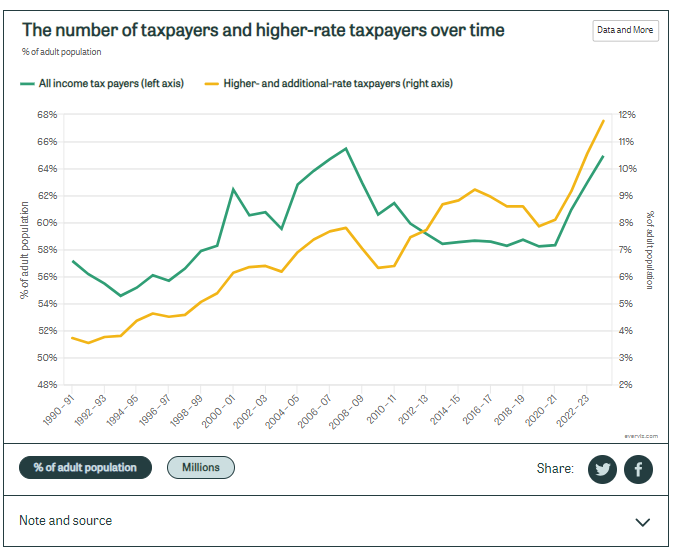
Higher rate taxpayers are 10% of the adult population: 6.5m people


what about the skew?

"In 2023–24 the top 1% of taxpayers (that is, those with incomes exceeding £214,000) received 13% of taxpayers’ pre-tax income and provided 29% of all income tax revenue." 

" The top 10% of taxpayers paid 60% of all income tax in 2023–24, up from 35% in 1978–79. The share of income tax revenue contributed by the top 1% of taxpayers rose from 11% in 1978–79 to 29% in 2023–24, despite big cuts in top rates of tax in the first 10 years of that period. 


Monday, 22 May 2023

What is chain drift?

 A nerdy blog. 

1. many goods have lots of variation in prices e.g. with sales

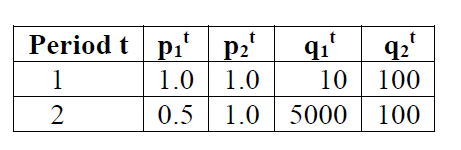
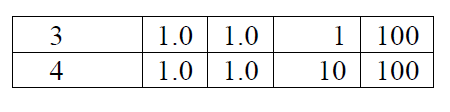
2. suppose, says Eriwn Diewert in Scanner Data, Elementary Price Indexes and the Chain Drift Problem

Revised October 13, 2021 we have the following data where good 2 is never on sale, but good 1 is and gets a massively changing set of quanties, rising in the time, then returning, but importantly, not instantly, to initial quantities


3. beccause the post sale adjustment, plausible if, for example, its a durable good, is slow, chained weights do not return back to initial levels. 

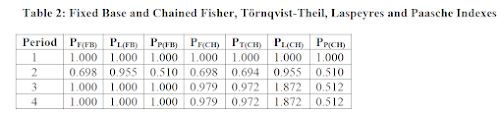
4. the table below shows "Table 2 lists the fixed base Fisher, Laspeyres and Paasche price indexes, PF(FB), PL(FB) and PP(FB) and as expected, they behave perfectly in period 4, returning to the period 1 level of 1. Then the chained Fisher, Törnqvist-Theil, Laspeyres and Paasche price indexes, PF(CH), PT(CH), PL(CH) and PP(CH) are listed. Obviously, the chained Laspeyres and Paasche indexes have chain drift bias that is extraordinary but what is interesting is that the chained Fisher has a 2% downward bias and the chained Törnqvist has a close to 3% downward bias."


Monday, 17 April 2023

GDP and health: stocks, flows, output and outcomes

 Interesting discussion at Imperial today.  

1. The health of a nation can be thought of as an outcome (e.g. premature death) and/or a stock (the number of heavy smokers) and/or a flow (number of operations performed per year). 

2. GDP is a flow.  It is the flow of output via people purposefully employed in producing that output flow.  It isn't outcomes.  So a healthy society via social norms or parents helping their children produces an outcome but not an output.  The output of health is operations done, patients seen.  Which can of course be measured better.

3. Missing markets.  Well, people at home are producing things as well.   Not only with modern working from home, but reading to children, looking after family all of which produces a flow of services.  But, we don't typically have that included in GDP since we don't know what price to allocate to that activity, since it's not an activity that's sold in the market.  We could make some assumptions e.g. by taking the market price of a carer working for a care home but typically we don't do this. 

4.  So, GDP doesn't necessarily measure well-being.  

5. In our Indigo Prize essay we explain more on GDP as a flow, adding up the flow of iPads, pencils and 737s, and going beyond GDP.  And the ONS produces a dashboard of health outcome indicators

Saturday, 4 March 2023

Policy-making under uncertainty: a case study

 A column by Megan Greene, FT, Dec 2 2021 reminds me of the omicron situation in Winter 2021.


November 30, 2021


The chief executive of Moderna has predicted that existing vaccines will be much less effective at tackling Omicron than earlier strains of coronavirus and warned it would take months before pharmaceutical companies could manufacture new variant-specific jabs at scale.

November 30th 2021

[Mr.Sahin is]...refusing to panic about the spread of Omicron, its newest variant. “I am personally not scared about the situation. We expected such a variant to come,” Ugur Sahin told The Economist in an interview. He is co-founder and chief executive of BioNTech,

December 1st 2021

Vaccines will likely protect against severe Covid-19 cases from the new omicron variant...WHO chief scientist Soumya Swaminathan said


Monday, 21 February 2022

Prospects for business investment

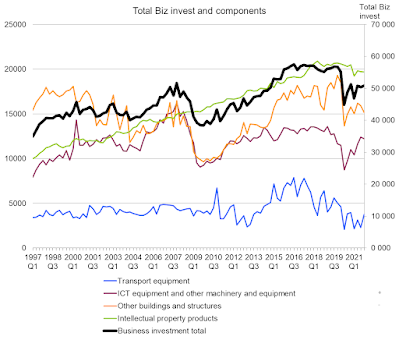
 The latest ONS business investment data, chained volume indices show 


What do we make of this? 

1. Overall investment took a beating in the financial crisis, then recovered. But it stalled again post the 2016 Brexit referendum.  It collapsed in the pandemic, and has not recovered.

2. The lack of recovery is mainly due to the fall in buildings, which has hardly recovered at all. 

3. IPP and ICT investment has stayed flattish and recovered respectively.

4.  Transport equipment, which is very volatile anyway has continued on a downward trend.  

5. Over the longer term, the constant is rising IPP investment.  ICT investment is not even back to pre-financial crisis levels. Buildings is back to 1997 levels. 

Wednesday, 13 October 2021

Friday, 28 May 2021

Explanations for low productivity growth: some history

As this paper nicely points out,  Shimaa Elkomy et al, "Energy and Productivity, A review of the literature" https://cusp.ac.uk/wp-content/uploads/pp-energy-report.pdf#ppem, the explanations seem to be rather the same: 


"For example, in 1966 Cambridge economist Nicholas Kaldor pointed to (and rejected) a number of common explanations for the UK’s declining productivity growth. Many of these reappear in the UK government’s recent industrial strategy (Table 2). Either we have made little progress in tackling these issues in the intervening half century, or we have missed a key element of productivity"


Kaldor, N. (1966) Causes of the Slow Rate of Economic Growth of the United Kingdom: An Inaugural Lecture. Great Britain: University of Cambridge Press

BEIS (2018) Industrial Strategy: Building a Britain Fit for the Future. Available at: 78 | CUSP WORKING PAPER No 23 https://assets.publishing.service.gov.uk/government/uploads/system/ uploads/attachment_data/file/664563/industrial-strategy-whitepaper-web-ready-version.pdf (Accessed: 29/04 2018)